“You can’t really mess anything up by building your own wheel” – thebiketube

I’ve wanted to build my own wheels for some time but have been reluctant to take the plunge. It’s not that I don’t have the patience, or the time to do it, it’s just that my DIY track record is, well, variable. But I want to be able to build wheels because of the flexibility it gives me to experiment more with my bikes…. swapping out derailleurs for hub gears, trying my favourite hubs on different rims… you know the kind of thing.  The other factor is that it’s pretty much impossible to buy a 27-inch wheel for an old bike with 120mm dropouts that will have the correct dishing to fit a 5 or 6-speed freewheel. When they do take a screw-on freewheel, modern 700C wheels seem to be designed for the single-speed brigade.

I’ve considered taking a wheel building course but don’t really want to give up a day or more for something that really shouldn’t be that complicated. Some of the YouTube videos are pretty clear, Sheldon Brown’s web site gives quite detailed instructions, and this book looked like good value at £9, so I bought it (even though I was a little nervous about buying from an author who describes himself as “one of the most respected professional wheelbuilders.”) I’ll post a review of the book when I’ve found out if it works.

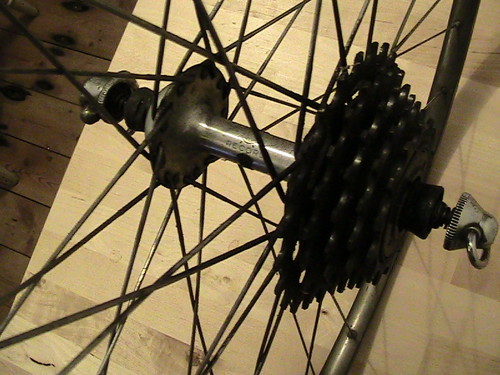
My first wheel build will use an old Campagnolo small-flange hub and a 700C Mavic G40 rim. I originally bought it as a complete wheel on eBay but I couldn’t get it perfectly true because the spoke nipples kept rounding off as I tried to turn them; they’ve seized to the spokes. I managed to remove a couple of spokes without damaging them (one from the drive side and one from the other side) and simply measured them to determine the lengths needed – there’s about 2mm difference between them.

Bicycle wheel
A leap in the dark – my first wheel build will actually be a rebuild of this Campy hub and Mavic G40 rim

Winstanley Bikes seemed to have a great range of spokes. (The biggest online bike retailers don’t come close.) I registered with them for the first time earlier today and placed my order. One hour and 35 minutes later, I had an email confirming that the spokes and spoke nipples has been sent by Royal Mail First Class. That’s great service…they might even be here tomorrow.

If thebiketube says, “You can’t really mess anything up by building your own wheel”, how tough can it be?  I’ll let you know…..

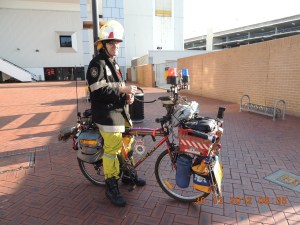
Chook’s rescue bike is equipped for any eventuality

Yesterday, New Year’s Eve, at Darling Harbour, Sydney, Australia, I witnessed one of the most heavily laden bikes I’ve seen in a long time. Dressed in full fireman’s gear (despite the 30 degrees C temperature), “Chook” (real name Anthony) volunteered for duty on his Ricardo bike to protect party goers against something…..although I’m not sure quite what. The bike appeared to be equipped with at least two fire extinguishers, various fire blankets, a long handled broom, emergency medical kits, a two way radio, multiple flashing lights and heaven knows what else.

Chook, Sydney, Australia
Fireman “Chook” fully equipped to rescue party-goers from danger in Darling Harbour, Sydney on New Year’s Eve 2012

I had a few words with Chook, who described himself as a disabled volunteer for various organisations, including the New South Wales Rural Fire Service. It just goes to show how much you can pack onto a bike if you try, and that lycra is not always the most appropriate clothing for the job at hand.

December 2012: two British giants of bicycle design and manufacture died this month

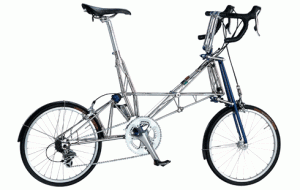
December 2012 has been a sad month for those who admire great bicycle design and manufacturing. Dr. Alex Moulton passed away on December 9th at the age of 92. The Moulton Bicycle Company that he built is in Bradford-on-Avon, Wilthshire, less than 3 miles from where I live. The company’s success is based on the revolutionary small-wheel, full suspension Moulton bicycle. Originally a rather utilitarian design popularised in the 1960s, a Moulton AM7 model was ridden to a speed of 51.29 mph over 200m at the 3rd International HPV Scientific Symposium in 1986 – a new World Unpaced Cycling Record. Moulton bicycles still enjoy an enthusiastic following throughout the world and the top model costs over £14,000.

New Series Double Pylon Moulton
Perhaps the pinnacle of Dr. Alex’s Moulton’s bicycle design genius: the New Series Double Pylon

Alex Moulton was first and foremost a brilliant engineer whose collaboration with Sir Alec Issigonis led to the development of Moulton suspension, including ‘Hydrolastic’ and ‘Hydragas’ systems that were adopted for several British cars, perhaps most famously the original Mini. Here’s the BBC New video reporting Alex Moulton’s passing.

Just 3 days after Alex Moulton’s death, Ron Cooper, master bicycle frame builder died. Born in 1932, Cooper, who raced bicycles in his youth, originally built frames for A.S. Gillott but left the firm in 1967 and started building frames under his own name.

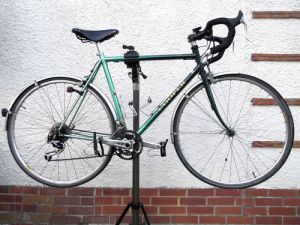
Ron Cooper bike
This touring bike may have been based on the the last frame built under Ron Cooper’s direction, according to the eBay advertiser selling it in December 2012

He believed that free hand brazing, done without the use of a jig, produces a better frame and his reputation for making great frames spread far and wide. By 1979 over half of Ron Cooper’s frames were sold to customers in the US. His workshop was most recently located in Deptford (S.E.London).

The Bicycle Book, Bella Bathurst – a book that really gets under the skin of what it is to be a cyclist

This is undoubtedly the best book on cycling that I read in 2012. It ranks alongside Mark Beaumont’s “The Man Who Cycled the World” and Rob Penn’s “It’s All About the Bike”, both of which were 2011 favourites. Bella really gets under the skin of what it is to be a cyclist and, presumably because she’s a writer first and a cyclist second, rather than the other way around, the writing style is deeply expressive and easy to read. She describes the different cycling “tribes” from racers to couriers and everything in between.

The Bicycle Book
A fascinating and beautifully written book about bikes, cyclists and the relationship between them

The various types of bicycle are analysed in some detail too. But most importantly, Bella captures the relationship between people and bikes, whether those people are commuters or top class athletes.

Today, some travel writers are jumping on the cycling bandwagon by penning what are essentially travel guides with the odd mention of a bicycle thrown in for good measure. The Bicycle Book is certainly not that. It’s totally  focused on bikes (including their history) and the people who ride them and, through a series of fascinating interviews says much about how those who build bikes (such as legendary frame builder Dave Yates) and ride them relate to their machines.

A new twist on drinking and driving….boozing and biking

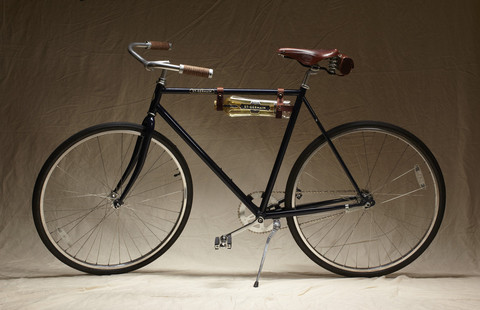
In a very imaginative brand extension, New York’s Cooper Spirits International LLC, which owns the St Germain French drinks brand, is selling a single-speed bicycle complete with bottle holder on the crossbar and a free bottle of the firm’s sweet spirit drink. The $1000 steel-framed bike, which is described as a ‘limited edition’ (although no numbers are quoted by the company) uses a coaster brake and combines combines clean, classic looks with some nice bits from Brooks, North Road and Michelin.

St Germain bicycle
The St Germain single speed bike comes complete with a bottle of booze to keep your spirits up

Choose a medium (20 inch) or large (23 inch) frame in any colour you like, so long as it’s navy blue.

Looking back at 2012: turning 60, turning pedals and Bradley winning the tour

At the start of my 60th year I was determined to have a good year’s cycling. I’m not a racer, and not even fast, but I do seem to have the stamina to stay in the saddle for up to 15 hours in a day without feeling totally wrecked at the end of the experience. That opens up opportunities to have fun on a bike, and in 2012 I did. To give you some idea of just how badly I’ve contracted the cycling bug, here’s a  short summary of my five most interesting and challenging rides during the year:

April 1st (my 60th birthday), I set out from Barcelona to ride my 61 year-old Thanet Silverlight back to the place where it was built – Elmdale Road, Bristol. The story is recorded here in my blog of the event. The journey is about the same distance as Lands End to John O’Groats, but sounds further, and the weather is usually better.

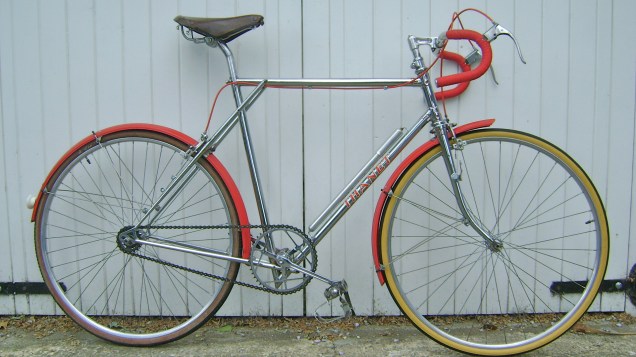
Thanet Silverlight
This Thanet Silverlight bike was made in Bristol and first sold on 22nd October 1950

Bike Bath on 24th and 25th June – 100 miles in the Mendips followed by 100 miles in the Cotswolds. Lesson learned: don’t take a road bike on routes planned by a mountain biker! However, it was seriously well organised and great fun. Details of next year’s event are here. I did these rides on my ‘best bike’  –  a Rourke steel frame with Campagnolo components.

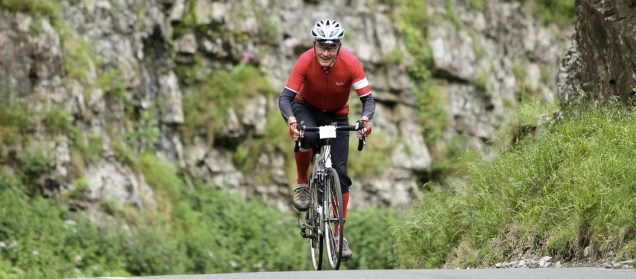
Cycling, Cheddar Gorge
Nearing the top of the Cheddar Gorge in Somerset during the Bike Bath Gladiator Challenge, 24th June 2012

July 22nd was forecast to be a glorious sunny day. The other forecast was that Bradley Wiggins would win the Tour de France. He duly obliged of course, becoming the first Englishman ever to do so. I didn’t watch the last stage of the race but instead took the opportunity to have my own little ‘Tour de Wiltshire”, a wonderful ride around my home county on the Wiltshire Cycleway. Usually quoted as somewhere between 160 and 165 miles, I clocked up 173 miles including detours, my longest ever solo one-day ride. Only during the Vatternrundan 13 years earlier had I ridden further in a day, and then there was a lot of support around. The weather was glorious, as is Wiltshire. Try the ride…but take time to savour the sights over 2 or 3 days, that’s what I’ll be doing in 2013.

My last big cycling event of 2012 was L’Eroica. I took my 1965 Hetchins Magnum Opus bike for this classic challenge but in deference to my knees, made up a compact double chain set from TA parts so I could manage most, but not all, of the amazing climbs on the 205km ride, thanks to the lower gearing available. The weather was overcast and reasonably cool for Tuscany, there was even the odd light shower – ideal cycling conditions. The atmosphere was amazing with around 5479 cyclists participating in the event. They were mostly Italians but included 1450 ‘foreigners’ from 33 other countries. Here’s a great blog post about the 2012 event from Wade Wallace (Melbourne, Australia).

I’ve already arranged travel for the 2013 event……

Postscript – the great Thanet tandem mystery

In preparing for the Barcelona to Bristol trip I did several rides on the Thanet, one of which took me along the Bristol to Bath Cycle Path just a few weeks ago. When I arrived at Bitton, where there’s a small steam railway and cafe, I met a bloke selling a couple of old bicycle parts from his van in the car park. He said that mine was the second Thanet he’d seen that week, and that the first one was a tandem.

When I got home, I checked Hilary Stone’s book and, sure enough, two Thanet tandems were made in the early 1950s, one for the firm’s owner, Les Cassell, and another that was sold to a “deaf and dumb man” in Bristol. I called Hilary and told him the story. He doesn’t know the whereabouts of either Thanet tandem, or indeed if both of them still exist. Clearly, one still does. Does anyone know of its whereabouts?

The Thanet Silverlight comes home after 61 years

He (Les Cassell) eventually bought the freehold of 50 Elmdale Road, Bedminster, for which he had his leg pulled by some of his friends for being a “bloated capitalist”.
Hilary Stone, Ease with Elegance, The Story of Thanet Cycles.

Yesterday, on the way over to Portsmouth on the ferry from Saint-Malo, I remembered a coaching inn on the edge of the Hampshire South Downs where Richard (my cycling pal from our village) and I had stayed last year en-route to Paris on our bikes. We’d enjoyed a great welcome and good food there. I did a quick web search on the iPhone and booked the last available room. The George and Falcon at Warnford doesn’t serve food on a Sunday evening but I was assured that Mat, who runs the place, would be able to make a sandwich for my scheduled arrival between 8:30 and 9:00pm.

The pub is 16 miles from the ferry terminal and I was pleasantly surprised to pick up a well-signposted cycle path through Portsmouth. I then climbed a long, steep hill up onto the South Downs. It seemed to me to be the toughest of the whole trip, but that may simply have been tiredness. The ride to Warnford was a bit of race against impending darkness because I managed to take the long way around again, rather than the most direct route. It rained intermittently, but I didn’t get soaked. When I arrived at my destination for the night, the promised sandwich was forthcoming, washed down with a couple of glasses of wine and I slept soundly through to 6:30am. It was raining when I left at 8:30 after a very good breakfast. The rain was to continue on and off all day.

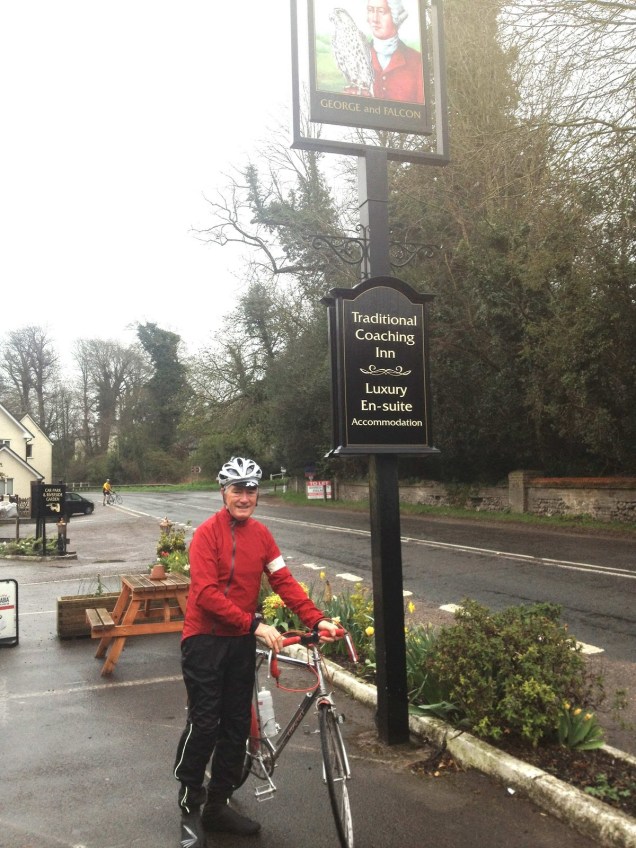
40810-img_0107Setting out in the rain from the George and Falcon for the last day of the trip.

The final day’s journey started with a climb onto the South Downs again as I headed for Winchester. My route then took me via Andover, Devizes, Melksham and Bath, before following the Bristol and Bath Cycle Path into Bristol. At one point, I ended up on the A34 dual carriageway north of Winchester and the traffic was horrific. I should have paid more attention to the map and gone through the centre of Winchester, picking up the Andover road without using the A34. I turned off the dual carriage with great relief at the first opportunity.

The day’s ride was pretty wet and windy but I was riding through wonderful countryside, crossing both the South Downs and Salisbury Plain. It got easier after Devizes, with very few hills and greater shelter from the wind. At one point, I passed within 2 miles of home but I was determined to achieve the original goal of taking the Thanet back to where it was made: 50 Elmdale Road, Bristol.

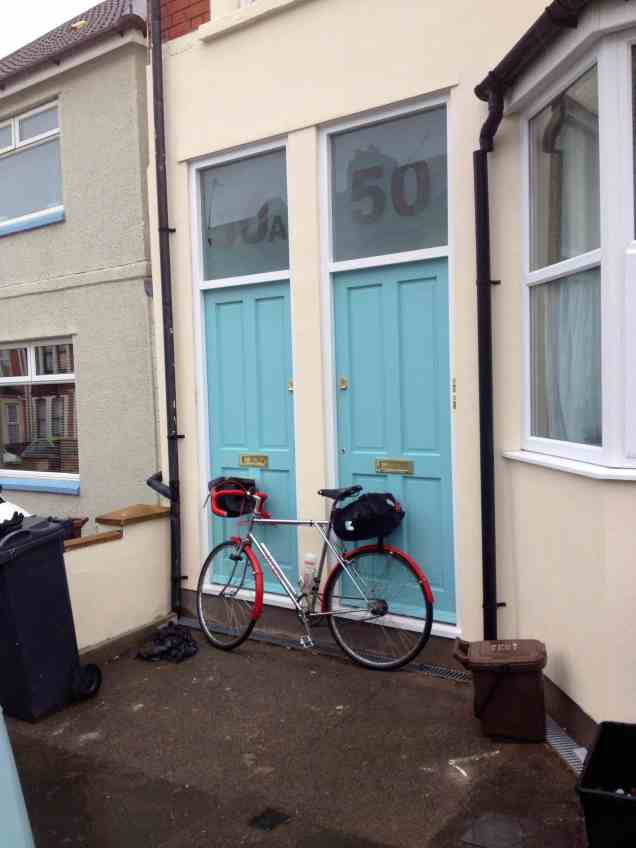
Riding along very familiar roads, I went through Bath onto the cycle path, the first major cycleway in the country created by Sustrans.  As I arrived in Bristol, the heavens really opened and I got my first and only major soaking of the whole trip. Finding Elmdale Road took about another 30 minutes, and when I arrived at my destination I was surprised to find that 50 and 50A, as they are now, had been subject to some serious development at the front and didn’t look at all like the building as it was in 2008. I actually double-checked to make sure I was at the right place, which I was. There were no answers when I rang the doorbells so I just propped the bike up outside and took my photographs.

IMG_0110
50 Elmdale Road, Bristol  BS3: the Thanet Silverlight comes home after
more than 61 years, but nobody else is at home.

According to my Garmin Edge 200 GPS, I had covered the 903 miles in 8 days 10 hours and 20 minutes. (Due to some finger trouble in St Emillion, the journey was actually split into two sections, Barcelona to St Emillion and St Emillion to Bristol).

I finally rode the 25 miles home to a very warm welcome from my family. Champagne, roast chicken and asparagus fresh from the garden. What could be better after 928 miles in the saddle?

What next? This looks fun: L’Eroica (and I do have a 1965 Hetchins bike in the garage that needs a good run).

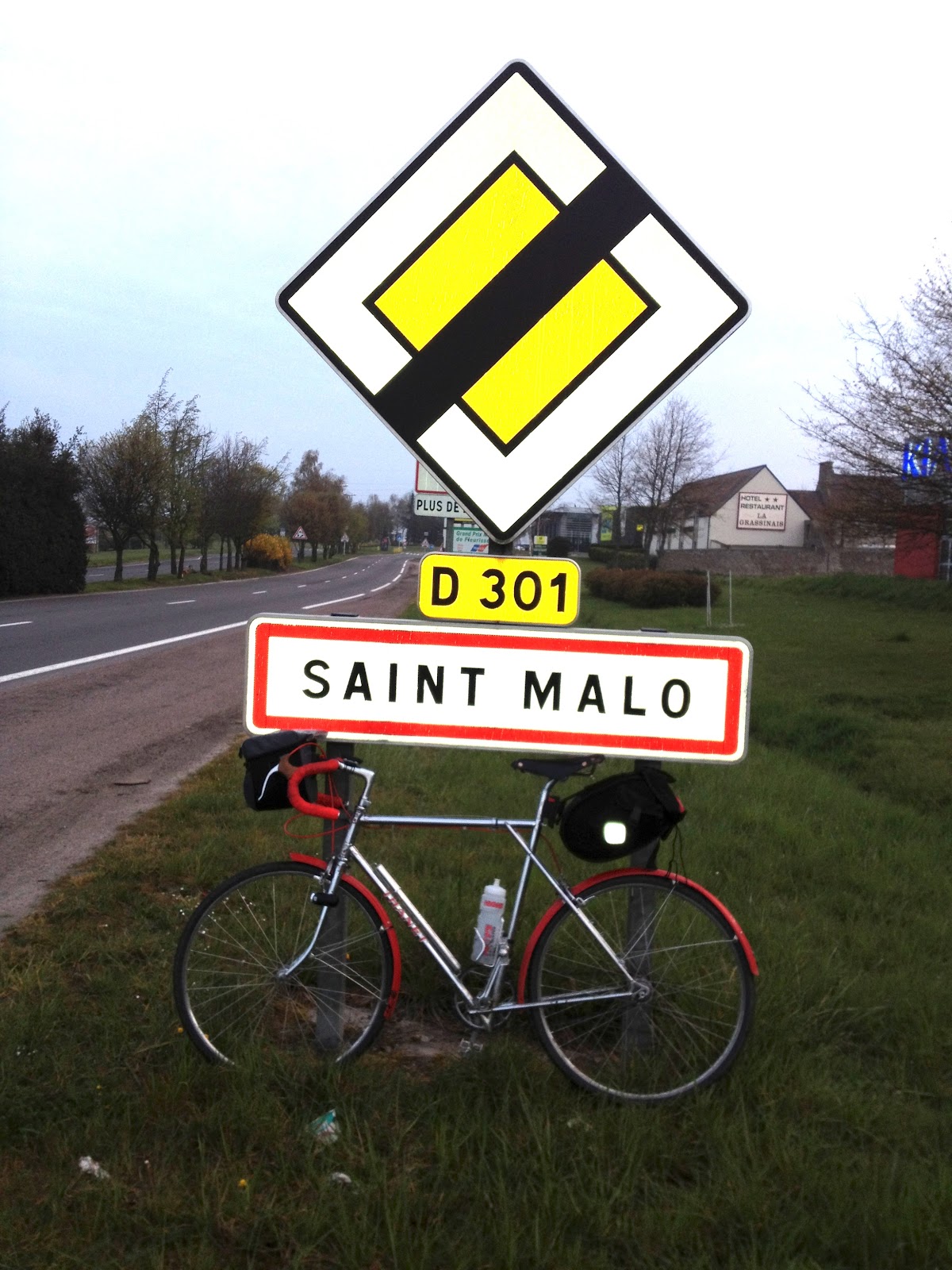
An early arrival at Saint-Malo, by 4 days

Saint-Malo (French pronunciation: [sɛ̃.ma.lo]; Gallo : Saent-Malô; Breton: Sant-Maloù) is a walled port city in Brittany in northwestern France on the English Channel. It is a sub-prefecture of the Ille-et-Vilaine.
Wikipedia.

I left Pouzages at 7am yesterday morning with the aim of putting in a big day. No big lunches, no relaxing coffee beaks, just head down and see how far I could travel. The temperature was 3C, according to a sign on the side of a commercial building but with the NNE wind still blowing it felt even colder.

At least the day started off brightly and the beginning of the journey, through rolling hills and hedgerow lined fields, was not unlike cycling near home in Wiltshire. The hills were quite hard work. However, most of the time the terrain provided some degree of shelter from the wind, so that was very welcome. (As I write this, I’m sat at lunch on the ferry to Portsmouth and the guy on the next table has just said that the weather forecast for Berkshire tomorrow is a 90% chance of rain and 25 mph winds – from the SW – again, not quite head on, but close enough!)
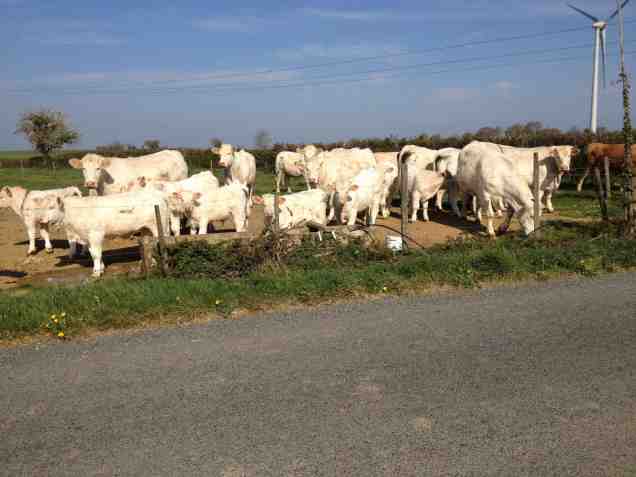
Cows
The countryside looked like Wiltshire, but the cows are different.

The crank continued to squeal in pain, but at least when it was squealing I knew that things were still tightly connected. It was when the squealing stopped and the clunking began that I knew things were falling apart. That happened just once during the day buy by now I was able to tighten everything up petty quickly.

Parts of the ride were once again along long, undulating Roman roads, some sections through forests. Because I was in a bit of a hurry, I was grabbing food at shops along the way. My diet was a disgrace – Danish pastries, croissants, energy drinks, chocolate bars and even Liquorice Allsorts (although I think the French version is called something else).

The ride took me over the Loire. In the past couple of days I had already traversed the Garonne, Dordogne and Charente rivers, as well as a host of minor ones, so if there’s ever a pub quiz question about naming major French rivers from south to north, I could be in the money. If the question’s about north to south, that would be tougher. The Loire crossing was by far the most picturesque with wide sandy beaches lining the banks as I cycled across an attractive suspension bridge at Ingrandes. The sun was shining, the terrain was reasonably flat, yet sheltered somehow from the worst of the wind, and I made good progress.
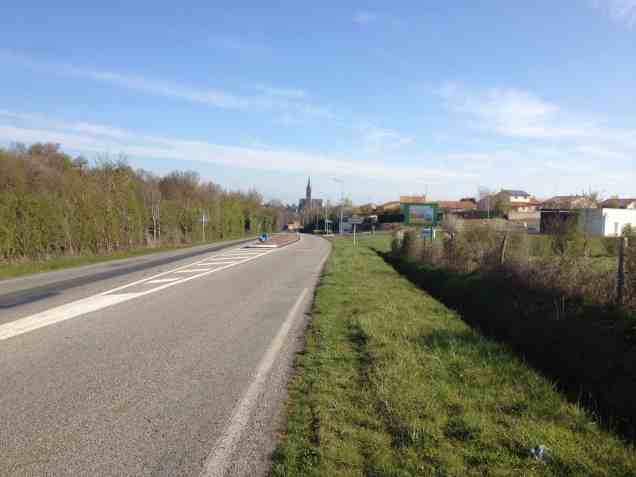
IMG_0097
The area just north of Ingrandes in the Loire valley provided some of the best cycling of the trip.

I had numbered my map sections for France from 2 to 13. Number 1 would have been Spain, but I hadn’t had a Spanish version of the Michelin maps I was using. I don’t think these exist. When folded to fit into the little plastic pocket on my handlebar bag, the depth of the map, as I traveled almost due north, represented about 18 miles, an hour and a half at my average speed of 12 mph. The towns, on average, seemed to be about 12 miles apart, so I was beginning to judge my likely progress for the day on this basis. As I set out yesterday morning, catching today’s ferry seemed a possible but rather challenging target. However, I knew that it would be a good time to cross back into the UK because most people visiting France for the Easter weekend would travel back on Easter Monday. For this reason I had decided to go for the greatest possible distance yesterday, timing the trip to end up in a feasibly large town where I would almost certainly have no problem finding a hotel.

At 135 miles for the day and 8:35 in the evening, that town was St-Aubin-d’Aubigne. I walked casually into a bar and asked for directions to the nearest hotel. In a repeat of the previous evening’s response, my request was greeted with a shrug of the shoulders and open palms. The husband and wife owners of the bar then dug out their equivalent of ‘Yellow Pages’ and made some phone calls. By 9pm they had reserved me a room in what turned out to be a lovely Auberge in the centre of the town of Sens-de-Betagne. I headed out of St-Aubin-d’Aubigne on a major road, part of which was a mile long section of dual carriageway. It was getting dark, still windy, and then the clouds that had gradually become more threatening throughout the afternoon became precipitous and I had to pull over and don the waterproof trousers and overshoes once more.

When I arrived at the Auberge La Tourelle about 45 minutes later, the restaurant was very busy but I received a warm welcome and sat down to a very good dinner at 10pm. A bit late, but I had to wash down the Liquorice Allsorts with something!

4am start this morning, in the dark with the odd rain shower, but arrived in St Malo at 7:40, seven days, almost to the minute, after setting out from Barcelona. I upgraded to a Commodore cabin on the ferry for about £85 and looked forward to an enforced rest after 790 miles in the saddle.
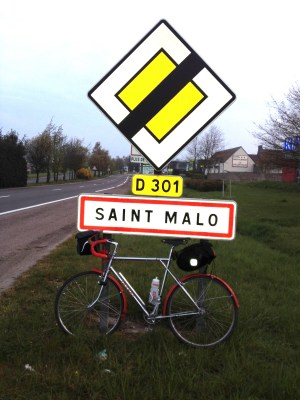
After 790 miles in 7 days and 10 minutes, I arrived in Saint-Malo.

Feeling great – just another 100 or so to go tomorrow but think I could be getting wet!
Still suffering from wind

For months the sky had remained a depthless gray. Sometimes it rained, but mostly it was just dull, a land without shadows. It was like living inside Tupperware.
Bill Bryson, The Lost Continent – Travels in Small-town America.

Nothing to do with the food – there’s been a 10 to 20 mph NNE blowing all day. I’m heading roughly north, tacking from left to right as the roads dictate, so I’m heading right into it a lot of the time and then struggling to make 8 mph on the level. You become very sensitive to your surroundings under these conditions. When sheltered by a hill, a few trees, or buildings, making progress is very much easier. When I made a couple of navigation errors and had to retrace my tracks, all I had to do was steer – the wind did the rest. This morning the wind was compounded by a leaden sky, a cold, penetrating damp, temperatures around 6C, and the occasional shower. The Roman road out of Jonzac was long, straight and undulating. As much as I love my cycling, this was damned hard work. I was reminded of Bill Bryson’s description of typical British weather being like “living insde Tupperware” – but I think he was living in Yorkshire at the time, so what did he expect!​

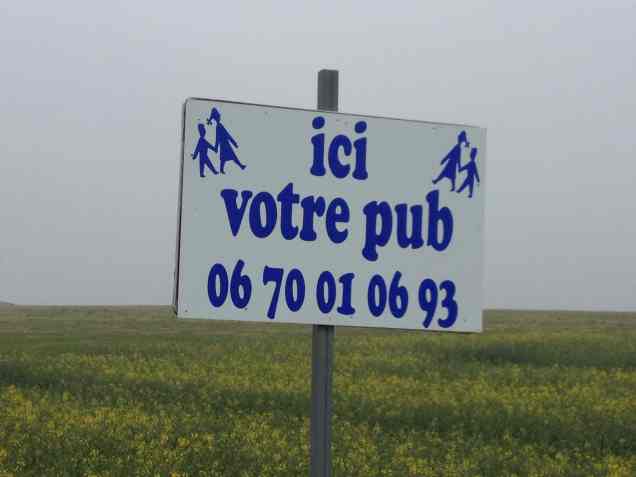
Pub
As I cycled through the Cognac region of France, under ‘Tupperware’ skies, it became clear that the locals like to encourage young drinkers!


Head down and battling, I arrived in Sureges at 1pm, I stopped at a restaurant in the central square where I followed the biggest breakfast I’d had in years with an equally sumptuous lunch. The meal, a great steak and chips followed by cheese and coffee, set me back £10 and the bar owner offered me another free coffee as I was paying the bill. I tightened the cotter pin again, the chain wheel had stopped squeaking but had been clunking for the past 10 miles because it was too loose to squeak. I then bought some batteries for the lights, thinking I might just need them today.

As I came out of the restaurant, the sun came out from behind the clouds and stayed out all afternoon. The riding, a mixture of rolling hills and long flat sections, was much more pleasant but still very hard work.

One annoying habit of some (a minority) of French drivers is to ‘toot’ to warn cyclists of their presence. This is entirely unnecessary of course because if you cycle on roads you expect to be overtaken by cars. Most of the roads were built for them. What you are not expecting is a blast in your left ear from Citroen’s latest electro-acoustic innovation. In the wrong hands it could be lethal.

I set my sights on Pouzages as a target destination for the day. A quick Internet search on the iPhone showed that it had several hotels. When, at 7pm, I arrived in a small village 20 miles south of Pouzages I was out of energy, out of water, and out of food. I ate a big chocolate and nut bar (575 calories, it said on the label) drank a Coke and a coffee and topped up the water bottle. Twenty undulating miles later, with the sun already below the horizon but enough remaining light to see my way, I battled up the steepest hill of the whole trip to reach the “centre ville” of Pouzages. It’s clearly a place designed to keep out invaders. I stopped at the first hotel I found, a bar with rooms really, and checked in. The barman told me that they will be open until 2am but I know that the noise is not going to keep me awake. Tomorrow, there is no rain forecast but the morning temperature is going to be just above freezing and the NNE wind remains. It was a bad decision to leave my knee warmers at home!