I’ve wanted to build my own wheels for some time but have been reluctant to take the plunge. It’s not that I don’t have the patience, or the time to do it, it’s just that my DIY track record is, well, variable. But I want to be able to build wheels because of the flexibility it gives me to experiment more with my bikes…. swapping out derailleurs for hub gears, trying my favourite hubs on different rims… you know the kind of thing. The other factor is that it’s pretty much impossible to buy a 27-inch wheel for an old bike with 120mm dropouts that will have the correct dishing to fit a 5 or 6-speed freewheel. When they do take a screw-on freewheel, modern 700C wheels seem to be designed for the single-speed brigade.
I’ve considered taking a wheel building course but don’t really want to give up a day or more for something that really shouldn’t be that complicated. Some of the YouTube videos are pretty clear, Sheldon Brown’s web site gives quite detailed instructions, and this book looked like good value at £9, so I bought it (even though I was a little nervous about buying from an author who describes himself as “one of the most respected professional wheelbuilders.”) I’ll post a review of the book when I’ve found out if it works.
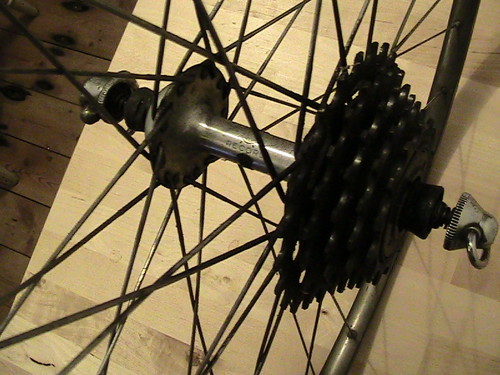
My first wheel build will use an old Campagnolo small-flange hub and a 700C Mavic G40 rim. I originally bought it as a complete wheel on eBay but I couldn’t get it perfectly true because the spoke nipples kept rounding off as I tried to turn them; they’ve seized to the spokes. I managed to remove a couple of spokes without damaging them (one from the drive side and one from the other side) and simply measured them to determine the lengths needed – there’s about 2mm difference between them.
A leap in the dark – my first wheel build will actually be a rebuild of this Campy hub and Mavic G40 rim
Winstanley Bikes seemed to have a great range of spokes. (The biggest online bike retailers don’t come close.) I registered with them for the first time earlier today and placed my order. One hour and 35 minutes later, I had an email confirming that the spokes and spoke nipples has been sent by Royal Mail First Class. That’s great service…they might even be here tomorrow.
If thebiketube says, “You can’t really mess anything up by building your own wheel”, how tough can it be? I’ll let you know…..
This self-published book by George Mahood is great fun. In Free Country: A Penniless Adventure the Length of Britain, George and a fellow adventurer set off to prove that the people of Britain are generous, considerate and generally good eggs. The experiment to examine this thesis involves setting off from Land’s End towards John O’Groats to complete the journey by bicycle. The couple’s only possessions at the start are a pair of union jack boxer shorts each plus a camera, notebook and pencil to record the journey. No bikes or alternative means of transport, no other clothes, no money. For 18.5 days they then blag their way to John O’Groats and cover the 1000 miles on the most unlikely bicycles, which were acquired along the way.
A heart-warming tale of British generosity, and cycling lunacy
There are interesting descriptions of the places visited but this is a travel book that’s much more about people than geography, revealing the stark contrasts in attitude that travellers might encounter on a bizarre journey such as this. And, before you ask, the Scots come out of if at least as well as the English for their generosity and good humour.
Towards the end of the book George comments, “It doesn’t cost anything to cycle or walk through the beautiful British countryside… It doesn’t cost anything to make new friends, and it doesn’t cost anything to smile and have fun.” Amen to that.
At £1.99 for the Kindle edition (£10.99 in paperback), this book is a steal.
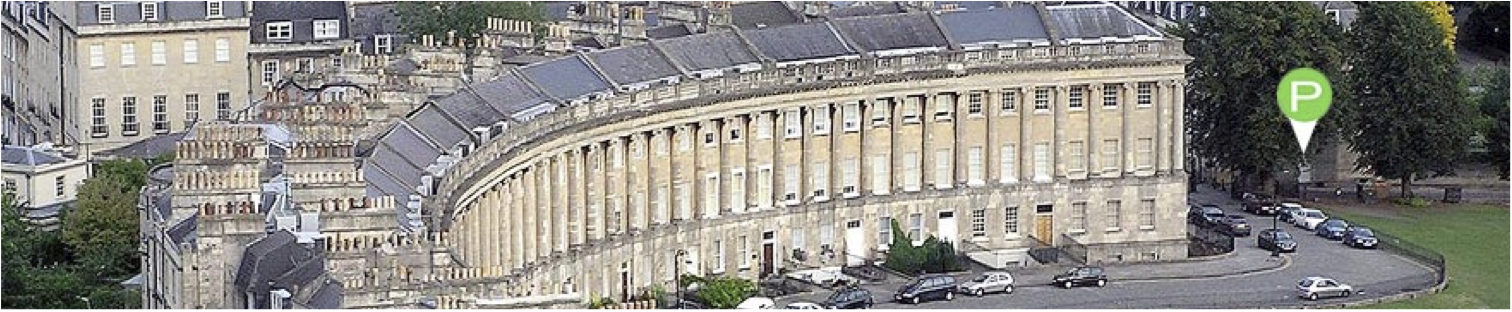
One of my favourite things about cycling to work is how great you feel when you arrive…alive, alert and ready to face the day. My commute is about 7.5 miles from South Wraxall in Wiltshire to my office that overlooks the Royal Crescent in the beautiful city of Bath.
My commuting destination, an office adjacent to Bath’s famous Royal Crescent
It starts with a 2 mile climb, nothing too strenuous, then a steep 2 mile descent into Bathford followed by a fairly level run into Bath, dodging the trucks and other traffic. There’s only a token gesture by Bath City Council towards this being a cycle friendly route. A few white lines on parts of the road through Batheaston and then a couple of minor diversions as the road narrows whereby the cyclist is taken briefly off the road onto the footpath before being thrown back into the path of following traffic about 10 metres further on. Whoever designed these ‘cycling safety lanes’ has obviously never ridden a bike in his life!
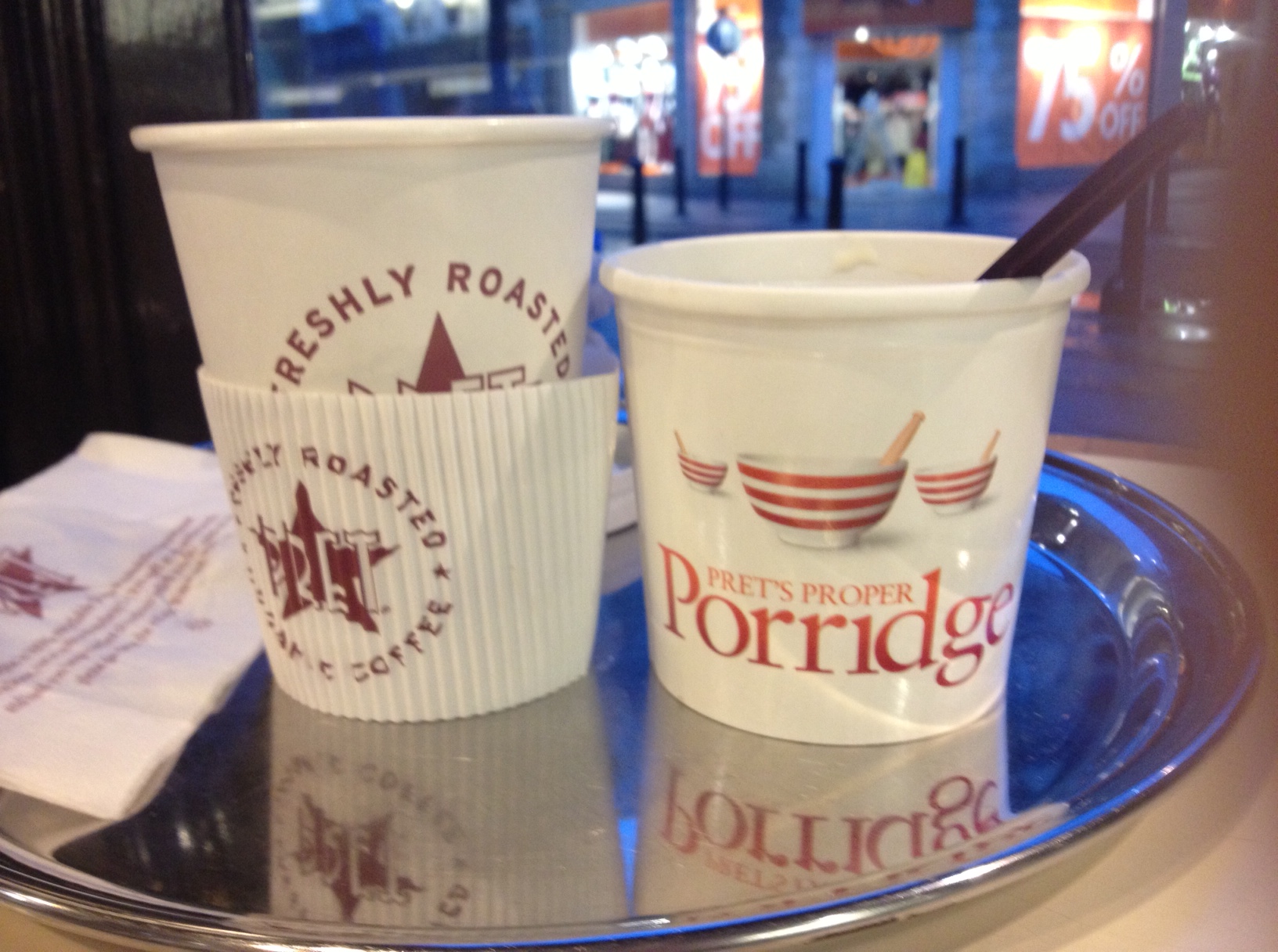
Chai tea and porridge..a reward to myself for the winter commute
This morning I set off in the dark, the only downside of which is having to dodge the potholes on the descent toward Bath. As I write this now, I’ve just finished breakfast: a pot of porridge with honey and a cup of Vanilli Chai tea (I keep wanting to call it Tai Chi, but that’s just my age..). This indulgent breakfast is my little reward to myself for not taking the easy option and hopping in the car. And in some ways it’s the best part of the day. Off to work……
As predictable as rain on a bank holiday Monday, the January consumer media are full of the latest diet advice. This year, even politicians are capitalising on the season’s hot topic to lambast the clinically obese, something that didn’t happen during John Prescott’s reign as Labour deputy leader – can’t imagine why not.
Nutrition advice is invariably interesting, confusing, irritating and depressing in equal measure. In the 1950s, the government’s advertised public health plea was to consume “plenty of milk, cream, butter and eggs”. As the clogged arteries of a generation took Britain to the top of the heart disease league, the advice changed. We’re now encouraged to take ‘five-a-day’ – portions of vegetables and fruit. Unfortunately, the food industry has negated the intent of this appeal by offering products that may well provide one of our five-a-day but contain a shed load of sugar and other additives too.
Three of my ‘five-a-day’ with no nasty additives (Image courtesy of Free Images http://www.freeimages.co.uk)
The cycling media are some of the worst offenders in peddling (no pun intended) nonsense nutritional products. Just take a look at the rubbish written about this bar of concentrated sugar. Few things are more offensive to the palate than sports drinks and energy bars yet BikeRadar give it 4 stars! I have yet to see a single credible piece of scientific research that proves the efficacy of sports bars over bananas, raisins, a bar of chocolate or a sandwich. And I’ve yet to eat one that isn’t revolting.
I know from experience that reducing carbohydrate intake and cycling more will burn fat and lead to weight loss. My doctor tells me that lowering my fat intake will help control blood cholesterol. And a recent BBC Panorama programme confirmed this Washington Post story from 2006 that high protein diets increase cancer risk.
Therefore, the solution is my ‘3 Zeros Diet’ : no carbs, no fat, no protein. But don’t blame me if you starve to death.
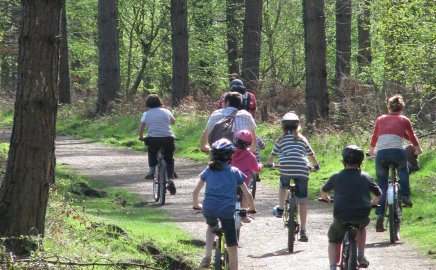
I am not by any stretch of the imagination a mountain biker. I do own a mountain bike, a hardtail built up from a second-hand Genesis Ti frame and some mid-range Shimano bits, but it’s normally shod with tyres more suited to tarmac than to mud. Riding a mountain bike from can sometimes be pleasant change from riding a road bike. A bit like getting out of a Ferrari and onto a tractor I imagine, although I’ve never owned either. There’s a soft and comfortable feeling to it, a sofa on wheels. Today, we made our second visit to the cycling centre in the Forest of Dean, Gloucestershire. It is a superb place to cycle with all the family (in my case my wife and 9 year-old twins, Harry and Matilda) and there are routes catering for riders of every standard, from casual to verging on lunatic.
Cycling in the Forest of Dean can be as relaxed or demanding as you like. This is not us…we all wear helmets!
We took the 20km family route of largely dry and undemanding trails with the occasional small diversion over humps and dips so that the kids can let off steam. Back at the start there’s a smart cafe, bike shop and workshop, and even somewhere to hose off your bike.
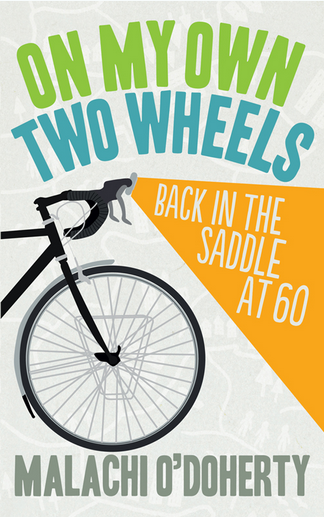
At the start, I thought I’d enjoy this book more than I did. I had taken up cycling seriously again at the age of 56 and the author at the age of 60. I thought we’d have a few things in common but, apart from the desire to lose a bit of weight, we didn’t. “On My Own Two Wheels” is a deeply introspective and rather sombre book and if you don’t know your way around Eire and Northern Ireland, then read it with a map your other hand, otherwise many of the journeys described will be rather meaningless. I battled through to the end of the book but I don’t think it ever succeeds in expressing the sheer joy and freedom of riding a bike; the author seems to take everything so very seriously.
A rather introspective and joyless book about cycling
However, one particular idea from the book stuck in my mind: “We had the wheel for about ten thousand years before discovering that one behind another was enough for an elementary vehicle…” I did a little more research. According to Wikipedia: “The oldest known example of a wooden wheel and its axle were found in April 2002 in the Ljubljana Marshes some 20 km south of Ljubljana, the capital of Slovenia. According to the radiocarbon dating, it is between 5,100 and 5,350 years old. It has a diameter of 72 centimetres (28 in) and has been made of ash wood, whereas its axle has been made of oak.” The predecessor of the modern bicycle, the dandy horse or Draisienne, dates from 1817. It is quite staggering to think that it took 5000 years for mankind to make the leap from wheel to bicycle. How could Leonardo da Vinci have missed this one yet still figured out the idea of helicopters, particularly when the earliest wheel was already the right size for a bike?
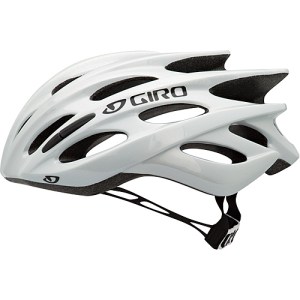
I’m as sure as anyone can be that a bicycle helmet saved me from more serious injury, or worse, when I had a cycling accident in 2010. On a bright, clear, May morning, as I was coasting downhill on my Airnimal Chameleon folding bike, a jogger emerged from between parked vehicles directly into my path. He didn’t even cast a glance in my direction. As I swerved to avoid him, which I did reasonably successfully, I lost control of my bike. I hit the ground hard and slid across the road, only coming to a halt as the back of my head hit the corner of a raised kerb with enough impact to leave a deep dent about 3 inches long in the helmet and leave me unconscious on the tarmac. A doctor friend of mine who was riding behind me is also convinced that the helmet was a potential life save in this accident. None of the drama of a car crash, or getting caught in the left-hand blindspot of a lorry, but this simple accident, which happened at about 15 mph put me in hospital for two weeks and out of work for six. Unsurprisingly, I’m a very strong advocate of wearing a helmet when cycling. But then again I always have been, and perhaps it saved my life.
Meanwhile the arguments for an against compulsory helmet wearing rage on, some supported by “scientific” papers and others by anecdote or “common sense”. The most recent CTC campaign brief (which by its very title suggests that it comes from a position of bias) is called “Cycle helmets: An overview of the evidence.” It pushes the same tired old arguments we’ve been hearing for years and even throws in some statistical equations to bolster its credibility. You would have to devote months of study to really get to the truth about the quality of most of the evidence presented and I am sure there will holes in the methodology and/or conclusions of most the papers referenced. And don’t forget, when giving an overview of any evidence, you can be selective in exactly which evidence you choose to review. How much of the evidence in favour of wearing helmets ended up in the waste bin under the reviewer’s desk? It’s not unknown for a researcher to respond to the question, “What do you think the result will be?” with “What result would you like?” The CTC has a clearly stated position and it’s not going to publish evidence that contradicts that position. To be fair, this most recent paper does cite 140 references to others, in case you’ve nothing on your plate for the next couple of years. But, having reviewed a random sample, the relevance of some of these papers to the arguments presented do seem rather tenuous and a large number of them are for studies conducted outside of the UK, where cycling conditions are often totally different to those encountered on our roads.
Is it really not worth £50 to reduce your chances of injury in some cycling accidents?
Despite my advocacy for helmet wearing, I agree with the conclusions of a paper published in the Journal of Medical Ethics last year (2012) that argues convincingly against the imposition of a legal requirement to wear a cycling helmet, except perhaps in the case of children. In a paper entitled “Liberty or death; don’t tread on me“, authors Hooper and Spicer provide a very coherent case for civil liberties to be to taken into consideration, whilst acknowledging that helmets do provide a degree of protection against head injuries in some instances (as concluded by the BMA’s research). If over 30,000 smokers die of lung cancer and tens of thousands die from alcohol related diseases, why should we legislate for the 200 or so deaths and 2000 or so injuries that are inflicted on cyclists each year, particularly when most of these outcomes would not be prevented by helmets, when we don’t prevent people causing themselves serious harm in other ways? (By the way, if somebody cycles for 50 years, don’t the numbers become a bit more scary: 10,000 deaths and 100,000 serious injuries over that period.)
I will always wear a cycling helmet because I believe I have benefited from that practice and may well do so again in the future. I would much rather that somebody took up cycling than be put off by a legal requirement to wear a helment, and we all have a duty to our children to do everything we can to protect them. I’m in the fortunate position that the cost of a helmet does not deter me from cycling at all, but I recognise that for some it probably does. I would rather they cycled without a helmet than not at all, so long as they understand that the head is a pretty important piece of kit, and of far greater value than the price of a helment. It’s also the heaviest part of the body and striking the ground with it is more than a little risky.
When I see others cycling without helmets, I don’t consider them to stupid. However, I do think that their decision is unwise and I will encourage them to reconsider. In this controversial matter, doing what we believe to be right does not mean imposing our opinions on others through legislative process. I just wish the CTC would stop clouding the issues with irrelevant data, and start promoting helmet use in a positive way. Or maybe the organisation is frightened of giving the government a stick to beat them with: “You think it’s important for cyclists to wear helmets, so why shouldn’t we compel them to do so?”
After the accident I mentioned at the start of this post, I was very ably supported by the CTC’s legal firm in gaining significant compensation from the jogger for the injuries I suffered. (Incidentally, the guy at no stage during my extended and painful recovery ever bothered to enquire about the state I was in, or even if I had survived the fall – despite the fact that was unconscious on the ground after the event.) The final irony of this story is that I was advised by Paul Kitson, the CTC’s legal eagle at Russel Jones & Walker, that if I had not been wearing a helmet, I may have received a lower level of compensation due to contributory negligence. How do you square that with the CTC’s neutral stance on the subject?
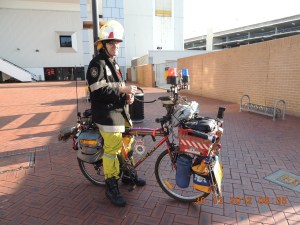
Yesterday, New Year’s Eve, at Darling Harbour, Sydney, Australia, I witnessed one of the most heavily laden bikes I’ve seen in a long time. Dressed in full fireman’s gear (despite the 30 degrees C temperature), “Chook” (real name Anthony) volunteered for duty on his Ricardo bike to protect party goers against something…..although I’m not sure quite what. The bike appeared to be equipped with at least two fire extinguishers, various fire blankets, a long handled broom, emergency medical kits, a two way radio, multiple flashing lights and heaven knows what else.
Fireman “Chook” fully equipped to rescue party-goers from danger in Darling Harbour, Sydney on New Year’s Eve 2012
I had a few words with Chook, who described himself as a disabled volunteer for various organisations, including the New South Wales Rural Fire Service. It just goes to show how much you can pack onto a bike if you try, and that lycra is not always the most appropriate clothing for the job at hand.
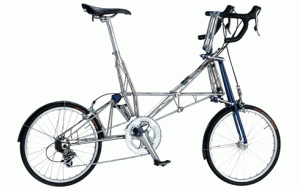
December 2012 has been a sad month for those who admire great bicycle design and manufacturing. Dr. Alex Moulton passed away on December 9th at the age of 92. The Moulton Bicycle Company that he built is in Bradford-on-Avon, Wilthshire, less than 3 miles from where I live. The company’s success is based on the revolutionary small-wheel, full suspension Moulton bicycle. Originally a rather utilitarian design popularised in the 1960s, a Moulton AM7 model was ridden to a speed of 51.29 mph over 200m at the 3rd International HPV Scientific Symposium in 1986 – a new World Unpaced Cycling Record. Moulton bicycles still enjoy an enthusiastic following throughout the world and the top model costs over £14,000.
Perhaps the pinnacle of Dr. Alex’s Moulton’s bicycle design genius: the New Series Double Pylon
Alex Moulton was first and foremost a brilliant engineer whose collaboration with Sir Alec Issigonis led to the development of Moulton suspension, including ‘Hydrolastic’ and ‘Hydragas’ systems that were adopted for several British cars, perhaps most famously the original Mini. Here’s the BBC New video reporting Alex Moulton’s passing.
Just 3 days after Alex Moulton’s death, Ron Cooper, master bicycle frame builder died. Born in 1932, Cooper, who raced bicycles in his youth, originally built frames for A.S. Gillott but left the firm in 1967 and started building frames under his own name.
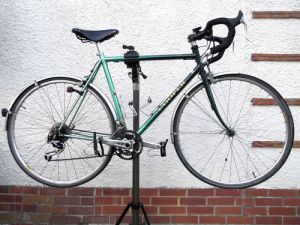
This touring bike may have been based on the the last frame built under Ron Cooper’s direction, according to the eBay advertiser selling it in December 2012
He believed that free hand brazing, done without the use of a jig, produces a better frame and his reputation for making great frames spread far and wide. By 1979 over half of Ron Cooper’s frames were sold to customers in the US. His workshop was most recently located in Deptford (S.E.London).
This is undoubtedly the best book on cycling that I read in 2012. It ranks alongside Mark Beaumont’s “The Man Who Cycled the World” and Rob Penn’s “It’s All About the Bike”, both of which were 2011 favourites. Bella really gets under the skin of what it is to be a cyclist and, presumably because she’s a writer first and a cyclist second, rather than the other way around, the writing style is deeply expressive and easy to read. She describes the different cycling “tribes” from racers to couriers and everything in between.
A fascinating and beautifully written book about bikes, cyclists and the relationship between them
The various types of bicycle are analysed in some detail too. But most importantly, Bella captures the relationship between people and bikes, whether those people are commuters or top class athletes.
Today, some travel writers are jumping on the cycling bandwagon by penning what are essentially travel guides with the odd mention of a bicycle thrown in for good measure. The Bicycle Book is certainly not that. It’s totally focused on bikes (including their history) and the people who ride them and, through a series of fascinating interviews says much about how those who build bikes (such as legendary frame builder Dave Yates) and ride them relate to their machines.



 Pedalitis