Socks and drugs and Pomerol

 “A cold wind was blowing from the north, and it made the trees rustle like living things.”
George R.R. Martin, A Game of Thrones

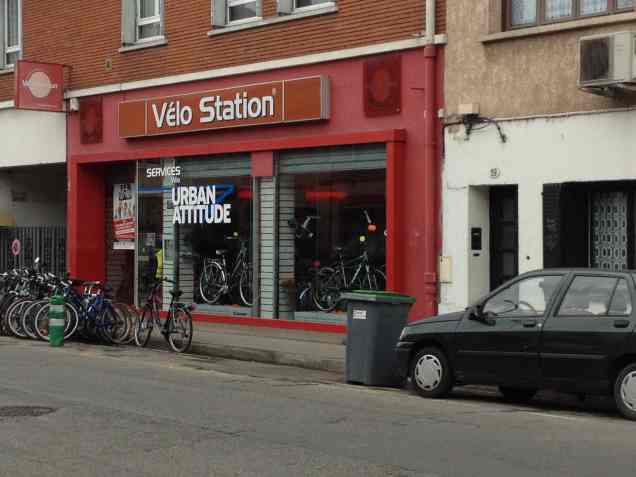
Whilst in Toulouse, I added to my sock collection with a rather striking pair of calf-length, German hiking socks. I may not be allowed into all restaurants wearing them but I think they look rather snazzy with the Rapha 3/4 trousers. I had a late start yesterday (Tuesday) because I decided to try the nearest bike shop for a fix for my squeaky crank. I arrived at 9, only to find that the didn’t open until 10. Impatient, I decided to live with the problem and headed out of town. However, having missed breakfast, I stopped at a patisserie for a bun. Another bloke, buying his sandwiches, opened a conversation by commenting on the socks. I’m not entirely sure what he said, but it was friendly enough. I explained the small problem with the bike and he enthusiastically recommended a bike shop to sort it out – Velo Station. I rolled up, had a new cotter pin fitted in a few minutes and set out without the squeak – for 5 more minutes. It is the axle that’s worn, not the pin, but I think it will hold out.
IMG_0071IMG_0070
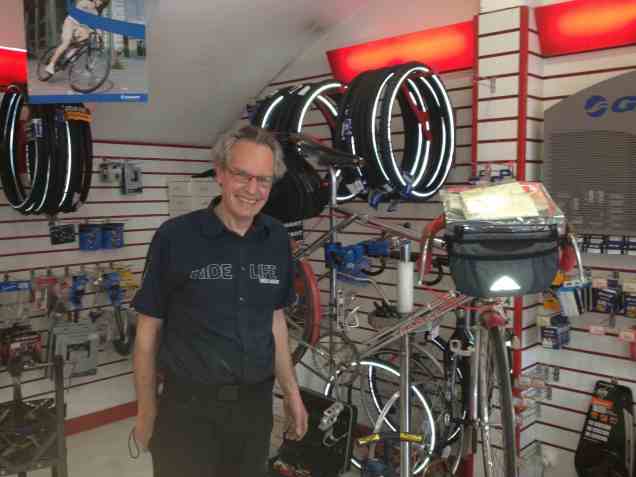
It took the owner of Velo Station in Toulouse  just a few minutes to replace my cotter pin.
Unfortunately, it turned out that it was the axle that was worn, not the pin. Nevertheless, great service, with a smile.

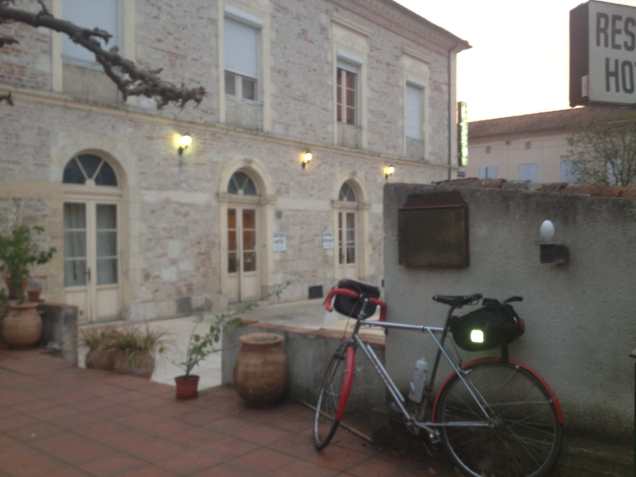
The day was spent traveling about 90 miles along the Canal du Midi. It’s about 5 times the width of our canals and the typical boat is a big white-and-blue cabin cruiser. I saw a lot of them in the moorings near towns but during the whole day saw just 3 boats moving along the canal. At this time of year, it is staggeringly quiet. A handful of other cyclists, a similar number of anglers, and a few dog walkers – that was it. I cycled for miles without seeing another soul – often with vast apple orchards adjacent to the canal. The was some very light rain, but nothing of significance. I’d had no particular destination in mind when I set out – the original target had been Agen, but I knew I would go further. At 7:30pm I found the town of Aiguillon. I walked into the only hotel in town, La Terrasse de L’Etoile, and booked a demi-pension: dinner, B&B. A 3-course dinner with wine and coffee, a very nice room, plus free WiFi and breakfast, set me back £50.
IMG_0082
La Terrasse de L’Etoile in Aiguillon: superb value and
very close to the Canal du Midi.

This morning, there was another 30 miles alongside the canal to La Reole, where I stopped for coffee to warm up – I don’t think that the temperature had risen above 7 degrees. The ‘Springwatch’ total for the canal was loads of coypu (which I’d originally thought were beavers – and are known as “little beavers” in some places), two cuckoos, quite a few herons, two green woodpeckers, one cormorant and a host of unidentifiable little brown birds.

North of La Reole are rolling hills and we’re back in wine country. I stopped in Sauverttere-de-Guyenne for a snack lunch and to make a few adjustments to the bike. I ‘d been suffering from some pain in both knees since yesterday morning and, whilst I am generally against drugs in sport, I succumbed to Ibuprofen to ease the pain. If this means a ten year disqualification from professional cycling, so be it. I’ve never done any anyway. On the way out of town I was flagged down by an enthusiastic Frenchman who explained that he owned owned a vintage Humber British bike with a 1926 Sturmey Archer hub on it. He also explained that Sturmey Archer enabled the first multi-geared bikes by introducing their original hub in 1904. Sometimes you find knowledge in the most unexpected places.

I continued cycling north, north-west. The wind was 5 to 10 mph north, north east. Not head-on but near enough to make things a bit challenging.

I tried to divert around Libourne by going through St Emillion then via the Pomerol vine plantations. However, I got lost, losing the best part of an hour in Libourne before getting back on route towards Montendre. Nice town. No hotels. Struggled another 12 miles north to Jonzach. Found a room immediately and ate very well here in the hotel. An English couple in the restaurant told me it’s due to be cold and wet for the next couple of days but 5 days into the trip, I’ve covered over 500 miles, including 110 today, so at least I’m ahead of plan.​

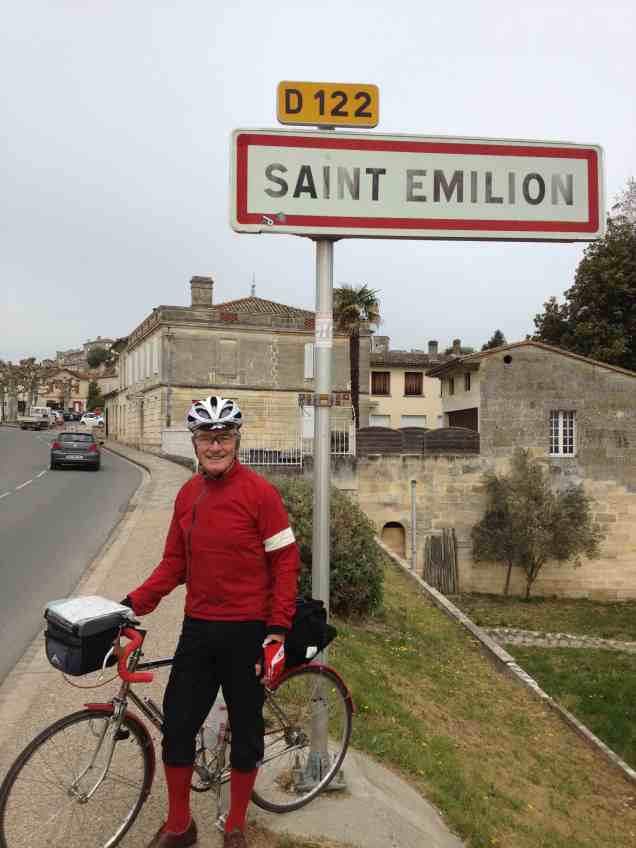
St Emillion
A Mexican couple kindly took this photograph of myself and the ‘velo’ on the edge of Saint Emilion.
It’s one very smart town with cobbled roads and is and surrounded by smart chateaux, including those that produce Pomerol.

Flamingos and beavers

 There is nothing – absolutely nothing – half so much worth doing as simply messing about in boats. Water Rat, Kenneth Grahame, The Wind in the Willows

I’m not sure which is harder to use, a French keyboard or the one on this iPhone. I’m beginning to wish I’d brought an iPad for the blog. Excuse any typos, I’ll sort them out later.

Anyway, two days on and I’m now in the centre of Toulouse, showered, refreshed and enjoying dinner in an Italian restaurant next to my hotel. The Novotel Centre Wilson in Toulouse opened 8 weeks ago and has a very nice carpet (ideal for cleaning the canal path dust off bicycle tyres) and an impressive new marble floor. I attracted a few strange looks as I wheeled my “velo” inside and propped it against the reception desk. Suprisingly, they not only let me have a room but gave me a free upgrade to an executive one – by far the best I’ve stayed in so far.

Yesterday morning I headed north from St Cyprien hugging the coast whenever possible and dodging the trucks on the busier roads when there was no other viable route. The resorts north of St Cyprien were much smarter, St Cyprien itself resembling a run down version of Weymouth. Beyond these were some idyllic French villages – real holiday brochure stuff and very quaint. At one point I was amazed to see flocks of flamingoes on both sides of me as I rode across a causeway just south of Bages. In my ignorance, I’d always assumed that they were tropical birds. There were skylarks everywhere too.

As I turned west towards Carcassonne the ride was very different. The main road was a traffic nightmare so I made strenuous efforts to avoid it, taking minor roads, some of them pretty roughly surfaced, through vineyards. I did Fitou and Corbieres yesterday, and perhaps some others that were not labelled!

I arrived in Carcassonne having travelled another 90 miles. I spotted an Ibis hotel on the way in and checked in without a problem to one of the smallest rooms imaginable – the receptionist apologised in advance. Arriving back after dinner, I met the “Ryanair refugees” as they had dubbed themselves – a bunch of Irish guys with no good way home today because French air traffic controllers were enjoying one of their hobbies again, going in strike.

The problem with the bike’s right hand crank was getting worse. The securing nuts on the cotter pin were at least holding good, but the chain ring continued to wobble and squeak. I had no idea how long this could go on before something significant happened.

This morning, after only a minor unintended diversion, I found the path alongside the Canal du Midi.

IMG_0060
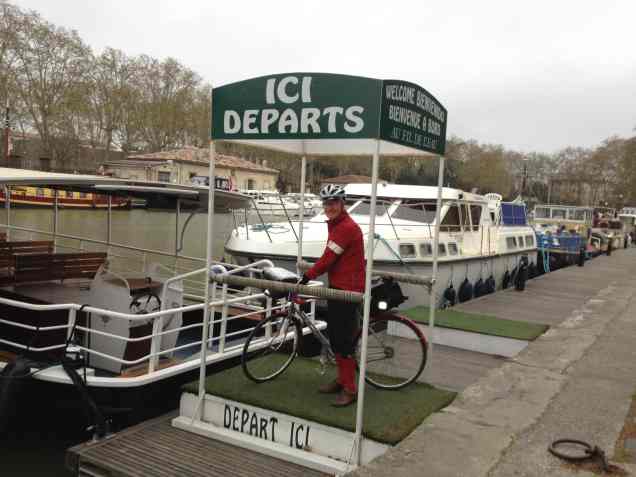
The start of my ride along the Canal du Midi in Carcassonne

This would take me to today’s destination, Toulouse, just over 60 miles away. A relatively short run. The whole day’s riding was amazing – I saw no more than another ten cyclists until I reached the outskirts of Toulouse. I did see a nuthatch and a couple of beavers – the beavers being another first ever sighting for me. (They turned out to be coypu – seek later post.)

The only thing marring the day, apart from some drizzly rain for an hour, was the bike’s technical problem mentioned earlier. I considered taking it to a bike shop in Toulouse but the truth was that it’s the 61-year old axle that’s the problem, and no bike shop was going to have one of those in stock. I concluded that my best bet was to fill the space between the cotter pin and the crank with the hardest version of Araldite, or it’s French equivalent. After checking into the Novotel at 4pm I scoured the town centre for the aforementioned adhesive but came unstuck. I’ll have to try again tomorrow, when it’s due to rain.

A Spanish map has limitations when the road signs are in Catalan

I set out at 7:30am on Sunday morning and then had a very frustrating hour and a quarter trying to find my way out of Barcelona. All the carefully typed directions that made perfect sense on Saturday night looked like complete gibberish by Sunday and the Barcelona authorities seem to design road signs to confuse any potential enemy, rather than to provide useful information for the traveller.

After finding my way out of the city there were long, steady climbs to Sant Celoni and some more challenging ones In the hills just south of Girona. But it was not as challenging for me as for the young guy cycling up the the opposite side of the road with a rucksack on his back, a set of window blinds in one hand and a ladder balanced across his handlebars in the other!

The N2 road from Girona northwards was very busy with cars and trucks but has a wide shoulder in most places. Scenery ranged from spectacular wooded gorges to industrial grot and at one point I accidentally ended up on the A2 – where cyclists are not allowed, so had to walk back 800 yards or so along the drainage trench. However, feeling good, I decided to press on into France. I crossed the French border at 6pm, calling Sally while I was at the highest point in the climb over the Pyrenees in the busy town of El Perthus,

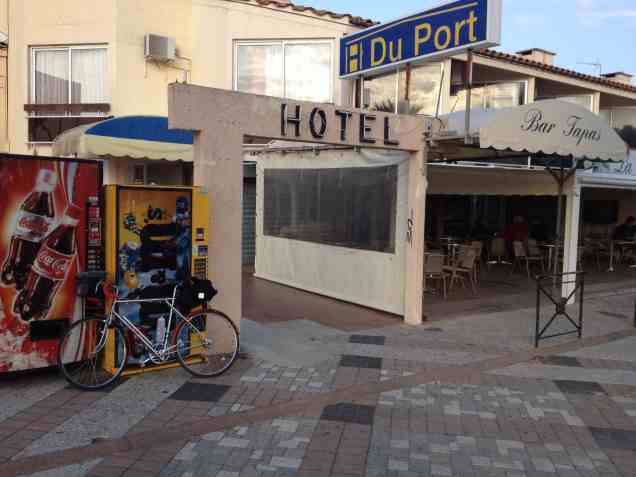
Hotel du Port

After a 5 mile descent, I turned right and headed for the coast, finding a room at the Hotel du Port in St Cyprien at about 7:45. I had covered 140 miles at an average speed of 12 mph and was ready for a bath and dinner.

L’Aquarium restaurant provided the latter – fish soup, turbot and creme caramel, washed down with a glass of rose and a dessert wine. I slept well!

The weather had been good all day, the temperature reaching about 25 C. The only problem with the bike was having to stop a couple it times to tighten a cotter pin on the right hand pedal crank. Somewhere along the way I need to find a fix for that. The search for a tube of blue Locktite starts today, but in not likely to find it cycling along the coast to Narbonne. Maybe when I turn left towards Carcassonne….

A dire warning and a small diversion

“Some serious advice. Stop. Get a bike with some decent gears. It’s a BAD idea!!” A few encouraging words from ‘Gearoldmuar’, November 17th 2011 on the Cyclists Touring Club (CTC) discussion board, in response to reading about my plans.
 
When you consider that Sturmey Archer (a Birmingham, UK, company) was selling over 2 million of its 3 and 4-speed hubs every year around 1950, and to all corners of the world, I think that Gearoldmuar’s suggestion that the product is not ‘decent’ is more than a little condescending, particularly when you consider that so many of them are still in service today, many of them probably having never been serviced. I wonder how many Shimano cassettes will be giving good service when they´re 60 years old.
All things considered, I think that my August 1949 Sturmey Archer FW 4-speed hub is unlikely to be the weak point of this trip, or my 1950 Williams C1200 chain ring. However, I do take the point that around the Pyrenees can be a tad hilly, so we fitted the hub with a 22 tooth sprocket. For the technically minded, I will now have a bottom gear of about 38 gear-inches. Gearoldmuar went on to recommend at a bottom gear of 27 gear-inches or, better still, 20.
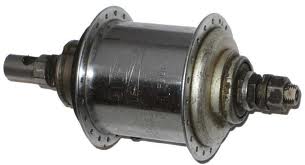
A really ‘decent’ set of gears: the legendary Sturmey Archer FW hub.  Every one is date stamped.
This one is from 1953, the one on my Thanet Silverlight is from 1949 and when stripped and examined by an expert in these things, he declared that everything still looked like new.
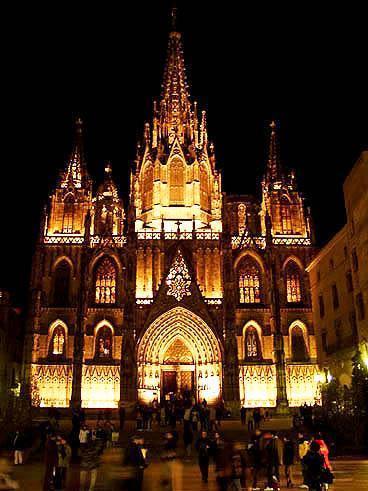
Despite my confidence in the set up, I am conscious that avoiding the worst of climbs is a good idea. So, when a cyclist overtook our car whilst traveling down the C61 from Sant Celoni to Arenys de Mar on the way to Barcelona yesterday, I decided that discretion was the better part of valour and opted to find an alternative route to the descent that was to have been tomorrow’s first big climb. So it is that in 10 hours from now, I’ll be setting out from in front of the cathedral in Barcelona (the original one, started in 1298 and finished in 1448, not the Gaudi “it will be finished soon, honestly” one, the Sagrada Familia, which is actually a basilica, not a cathedral and is still under construction) to head north-east from the city instead of due north. It’s a 30 mile climb to Sant Celoni, but none of the hills is big enough for “MapMyRide.com” to categorise it numerically. That must be a good thing, mustn’t it?
The starting point: Barcelona’s only cathedral was built between 1298 and 1448.  The scaffolding is just coming down after several years during which all the stonework has been cleaned, so it will be looking its best again very soon, but there’s still a lot of scaffolding to go (March 31st, 2012).
I’ve just enjoyed a fabulous dinner with my brother-in-law James, his wife, Pepi, and their 3 children – Victor, Arthur and Ivan –  in their lovely apartment two blocks away from the cathedral. Home-made paella with a veritable fest of seafood that always tastes so good here, a modicum of fine Spanish red wine and plenty of water to keep up the hydration. I’ve read all about the importance of hydration!
I plan to set out at about 7:30am, and hope that the confusion of directions we’ve prepared to get me out of Barcelona city make more sense in the morning than they do now. I also hope that being 60 tomorrow doesn’t suddenly make me feel much older. I’ll know for sure one way or the other tomorrow.
My first destination is Girona, or maybe a bit beyond if all goes better than expected. The temperature should hit the low 20s Centigrade and there’s no rain forecast.

On our way

“Tourists don’t know where they’ve been, travelers don’t know where they’re going.” Paul Theroux.
I started writing this from the little Internet cubicle of the Ibis Hotel in Chateauroux, a small town between Orleans and Limoges. I was typing very slowly due to the infuriating transposition of keys that gives the French keyboard its unique personality!

Having traveled nearly 600 miles since leaving home yesterday morning, we’re now heading south on the A20 motorway, somewhere around Limoges. Paul’s driving while I tap out this entry on the iPhone.

Chateauroux was a typically pleasant small French town where we found a small, inexpensive bistro and enjoyed a good dinner. Poached eggs in kidney gravy is not the kind of thing we eat at home and is indicative of the different palette of the French.

The weather is fantastic – it will reach about 20 deg C today and there’s not a cloud in sight. If I get two weeks of this, the ride will be amazing.

We’re aiming to get at least as far as Perpignan today and may even go over the N2 into Spain then head to the coast to find a seaside hotel for tonight somewhere north of Barcelona. We’ll travel the two hills that I need to tackle during the first two days of the ride – the N2 over the Pyrenees and the C61 from the Spanish coast to Saint Celoni. It will be the first time I get a true sense of the scale of the challenge.

In the meantime I’ve noticed some play in the front wheel of the bike and I’ve developed a cold. So far, so good!

The plan

“A journey is like marriage. The certain way to be wrong is to think you control it.” John Steinbeck.
 
As I mentioned in my first post, my goal is that my 60 year-old legs propel my 61 year-old Thanet Silverlight bicycle to the city where we were both born – Bristol, England. The Thanet frame was made at 50 Elmdale Road, Bedminster, Bristol. The building is now two domestic dwellings, 50 and 50A.  With luck we’ll both arrive on the morning of Saturday 14th April, having set out from Barcelona on 1st April, then I’ll pedal the rest of the way home to South Wraxall, near Bradford-on-Avon, a gentle 25 miles and only one final climb, Bathford Hill, about 2 miles from home. 
My final destination: the birthplace of my Thanet bicycle is now two private dwellings: 50 and 50A.
This shot is from 2008 when it was last sold, hence the estate agents’ sign.


One of the things that makes this trip exciting is its unpredictability. I don’t know if either the bike or I will last the pace. I don’t know what the weather’s going to be like. I don’t know the terrain, apart from what I’ve read. And I don’t yet know where I’m going to stay each night because I don’t know when I’ll be tired. Having said all that, I do have a planned route and some rough timing for the trip. This is it:
 
Day 1: Barcelona to Girona                    106km
Day 2: Girona to Perpignan                    107km   
Day 3: Perpignan to Carcassone             120km
Day 4: Carcassonne to Toulouse             91km
Day 5: Toulouse to Agen                        106km  (530km stage 1)
Day 6: REST
Day 7: Agen to Libourne                        123km
Day 8: Libourne to St Savinien              126km
Day 9: St Savinien to Les Epesses         130km
Day 10: Les Epesses to Pouancé            110km
Day 11: Pouancé to St Malo                   135km (624km stage 2)
Day 12: REST (FERRY DEPARTS 10:45)
Day 13: Portsmouth to Bristol                90km
Day 14: Bristol to Bath                           30km

TOTAL                                1274km….791 miles
 
In practice, I expect to cover nearer 800 to 900 miles with diversions, intended and otherwise. And I don’t really expect much to go to plan. If things go better than expected, and both the bike and I are up to it, we may even add on another 100 or so miles at some point to make it a 1000 mile trip. Perhaps going onto Cherbourg, rather than returning home via St Malo. However,  I’d be very happy to just achieve the original objective.
 
I took the Thanet for a final spin today, just a few miles. Something didn’t feel quite right and, sure enough, when I got back I found that a cotter pin had worked loose again and the crank had some movement in it. I tightened it up and added a lock nut for good measure. At least old bikes are pretty basic and, for the most part, you don’t need sophisticated tools to keep them going.
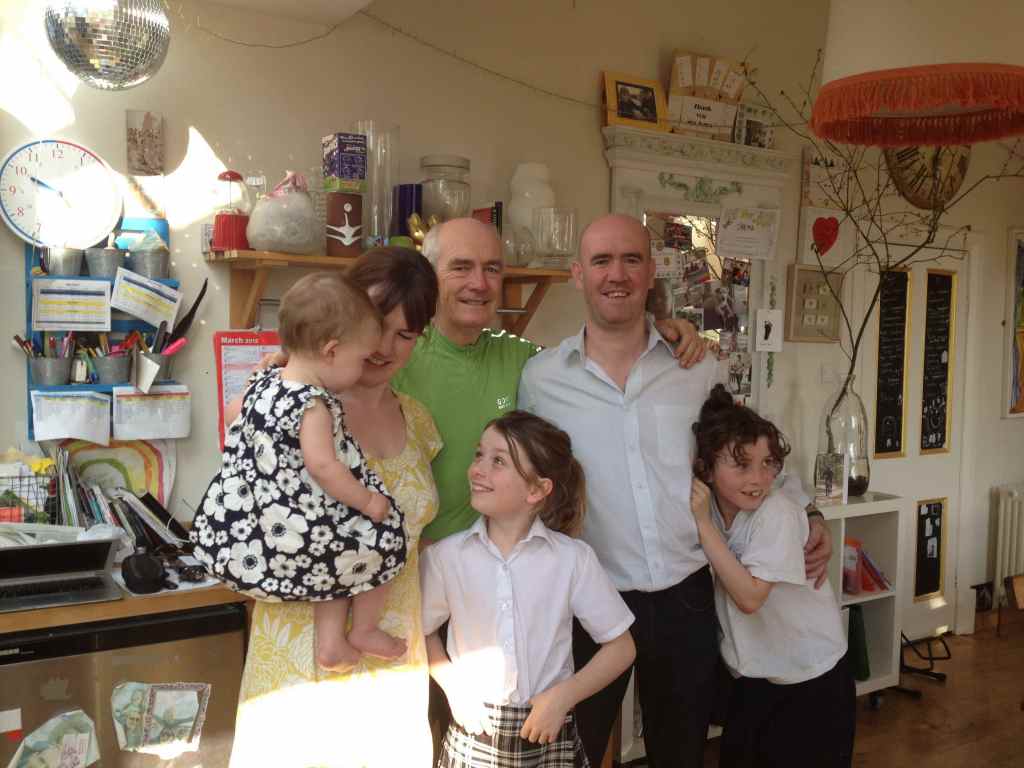
When I got back from the ride at about 4 o’clock this afternoon I had a surprise tea party, arranged by my wonderful wife, Sally, and attended by my four children – Adam, Heather, and twins Harry and Matilda  (actually two adults and two children) and my lovely granddaughter, Charlotte Rose.
 
Now I’m just about to print out the checklist, panic about the things I may have forgotten, and load the bike into the car…
 

One more day to get ready

“As you get older three things happen. The first is your memory goes and I can’t remember the other two…” Norman Wisdom
I’ve only one more full day to prepare before traveling to Spain. That’s because I’m going over to meet my companion for the drive to Barcelona, Paul Whytock, first thing on Thursday morning. Paul’s been a friend for nearly 30 years and we’ve made trips to continental Europe together. We’re going to take the bike through the Channel Tunnel in my 10 year-old Mercedes estate and drive to Barcelona, hoping to arrive on Saturday morning. All being well, we’ll then meet Paul’s wife and daughter at Barcelona airport because they’re coming over to join him for a weekend in the city before they all drive back. I will be setting out on my own on Sunday morning.
I recently read about super lightweight touring in CTC magazine. Igor Kovse rode the 100 Cols Tour, a 4,000km jaunt, with just 3kg of luggage in a compression bag tied to his saddle and saddle post.
A 2006 Himalayas photo from Igor Kovse’s web site: he’s a big fan of really lightweight touring
The idea of lightweight touring really appeals, but the convenience of a clip-on handlebar bag with a map pocket on top and a clip-on seat post bag won the day. One recommendation of Igor’s that I will follow is to make up some typed directions (when I find time), rather than relying upon map reading whilst pedaling. Unlike Igor, I will be taking maps , or at least sections of maps, as a back up. Also unlike Igor, I won’t be wearing Crocks to save weight.
On the subject of cycling apparel, I’ve done the lycra thing but in the past few months have developed a real taste for Rapha clothes (most of them – see below) and Dromarti Storica classic-look leather cycling shoes. Three-quarter length trousers, colourful knee-length socks, and some touring shorts in case it gets a bit warm, will be the order of the day. I’ve got knee warmers for the early mornings and a cap to wear under my helmet in the beating sun. A classic style for a classic bike – even if it does get strange looks from the boy-racer cycling brigade. One word of advice. Don’t buy the Rapha padded merino wool boxers to wear under your cycling trousers. Not only are they very expensive at £40 a pair (and I was dumb enough to order two pairs) but the designer decided that it would be a good idea to have exposed stitching on the inside of the pants where the pad is fixed into place. The rough edge acts as a very effective file on the inside of your thighs and, at least in my case, rubbed them raw after 20 miles!
I’m a great believer in helmets and, after a nasty fall two years ago when a jogger decided that it must be safe to run across the road because he couldn’t hear anything. He heard me using my nose and forehead as brakes on the tarmac a few seconds later, and then a rather loud crunch as the back of my head contacted the kerb on the other side of the road. Fortunately, my very good friend Richard Stanton, another cycling nut and a doctor, was 50 yards behind and witnessed the whole thing. When I say he’s a doctor, he’s actually a consultant psychiatrist so, after checking my physical injuries, helped me manage my anger when I later regained consciousness. Anyway, we are both convinced that without the helmet, even in a 15 mph collision, I would have been very much worse off. If I was still here at all.
Less than five days to go before the real journey begins. The Mercedes failed its MOT last week on brakes. On a test ride two days ago, one of the brake levers fell off the Thanet, there was a regular squeak from the bottom bracket and a loud clunk for each revolution of the cranks. The clunk turned out to be a loose cottered crank.
This is going to be fun, isn’t it?

Preparing the bike

“Old age is always 15 years older than I am.” Bernard M. Baruch

Six days to go. My excitement is only matched by the feeling of being unprepared, despite nearly a year of preparation.

There have been a few minor concessions to modernity as I’ve prepared the bike  for the trip – all 800 to 900 miles of it, depending how much I get lost. Here’s the technical stuff.

When I bought the Thanet Silverlight it had a single, fixed gear, as originally manufactured. The maker, Les Cassell, used to recommend that the bike was supplied with a single fixed sprocket, like mine, or a 4-speed Sturmey Archer hub. Over the last year, I’ve had a couple of wheels built up with Sturmey Archer hubs, one with an FC close ration hub and the other a wide-ratio FW type. By putting a larger sprocket (22-tooth) onto the 1949 FW, to complement the original Williams 48-tooth chain ring, I’ve managed to have the gearing lowered to match the capabilities of 60-year old knees. At about 20 mph the cranks are spinning freely but, apart from when coasting downhills, I don’t want to ride any faster than that. Having lower gears for the big climbs is more important on this trip. I don’t need to get anywhere fast, but I do need to get back.

Ben Abbots checks out a 1949 Sturmey Archer hub for the Thanet in John’s Bikes, Bath – not a trace of carbon fibre in sight!

I’ve changed the stem for a longer one (a Nitto) because the original was too short and the weight distribution on the bike meant it had a tendency to shimmy. (If you’ve never experienced shimmy, take a look at this. It’s always frightening, and can be fatal!) The longer stem improved the situation and adding a small handlebar bag, plus a small Carradice bag fixed to the seat post, seems to have made the bike much more stable.

The only other modifications were to replace the brake blocks with longer mountain bike versions, the addition of lightweight pedals and strapless toeclips (a friend’s recent accident has made me wary of being strapped onto pedals – the leg break was very nasty!), and the use of relatively modern luggage, plus a Garmin Edge 200 GPS – just for tracking mileage and average speed.

Throughout the year of bike preparation, the help and advice I’ve had from Ben Abbots, a music student and qualified bike mechanic who works part time at John’s Bikes in Bath, has been invaluable. As a young bloke, Ben’s knowledge of, and enthusiasm for, vintage bikes is astonishing and he’s tackled every task on the Thanet with real commitment. I’m not sure this trip would be possible at all if it had not been for his help.

About the bicycle

“It’s sad to grow old, but nice to ripen.” Brigitte Bardot

For most of what I know about Thanet bicycles, I have to thank Hilary Stone. Hilary, who lives in Bristol, and was a cycling journalist. I don’t know if he still writes about cycling but his book ‘Ease with Elegance’ subtitled ‘The Story of Thanet Cycles’ (ISBN 0 9512026 0 X) charts the history of the Thanet marque.

Hilary Stone’s little booklet traces the history of the Thanet marque.
Produced as a limited edition of 1000, he still has a few copies for sale (£8.50).


When I met him, he confirmed that Thanet was the only bicycle manufacturer in Bristol in the early 1950s and it was he who told me that my Thanet, frame number 1533, was originally produced with a half-chrome, half-paint finish. The full chrome frame that it sports today was clearly part of refurbishment at some time in its history, probably more than 30 years ago.

Having discovered the existence of Thanet cycles, and the Silverlight model in particular, the next task was to find one. Hilary Stone had sold one just a few months before I started my search in May 2011. I thought that I may be able to buy it from the new owner but was dismayed to find it had been shipped to Australia, so the chances of that were very slim. It was very fortuitous that one appeared for sale on eBay just 2 weeks later. With 3 days of the auction to go, there were no bids. I contacted the seller, Bob Johnson, drove to Shepperton to see the bike and bought it on the spot.

Bob explained that the bicycle had previously been owned by his business partner, Jake Riviera (real name Andrew Jakeman), one time owner of world-famous Hetchins cycles, and perhaps best known as the co-founder of Stiff Records. Having stared making frames in 1934, Hetchins is still in the bicycle business today. On other aspects of the Thanet’s history, Bob was rather more vague. I got the impression that he had little interest in the bike, other than selling it for a good price, but for me it was a remarkable piece of luck to have found it. Only one other has appeared on eBay in the last year, and it didn’t look nearly as pretty, which matters.

The challenge

 “Inside every older person is a younger person – wondering what the hell happened.”
Cora Harvey Armstrong

Seven days from now, at 7:30am on April 1st, 2012, I’ll set out from the centre of Barcelona, Spain. I’ll start my journey from the old cathedral square, to cycle to Bristol, UK. I have to be home, near Bradford-on-Avon in Wiltshire, by midday on 14th April because my wife’s parents are celebrating their 50th wedding anniversary with a party at our home. It’s a party I can’t miss.

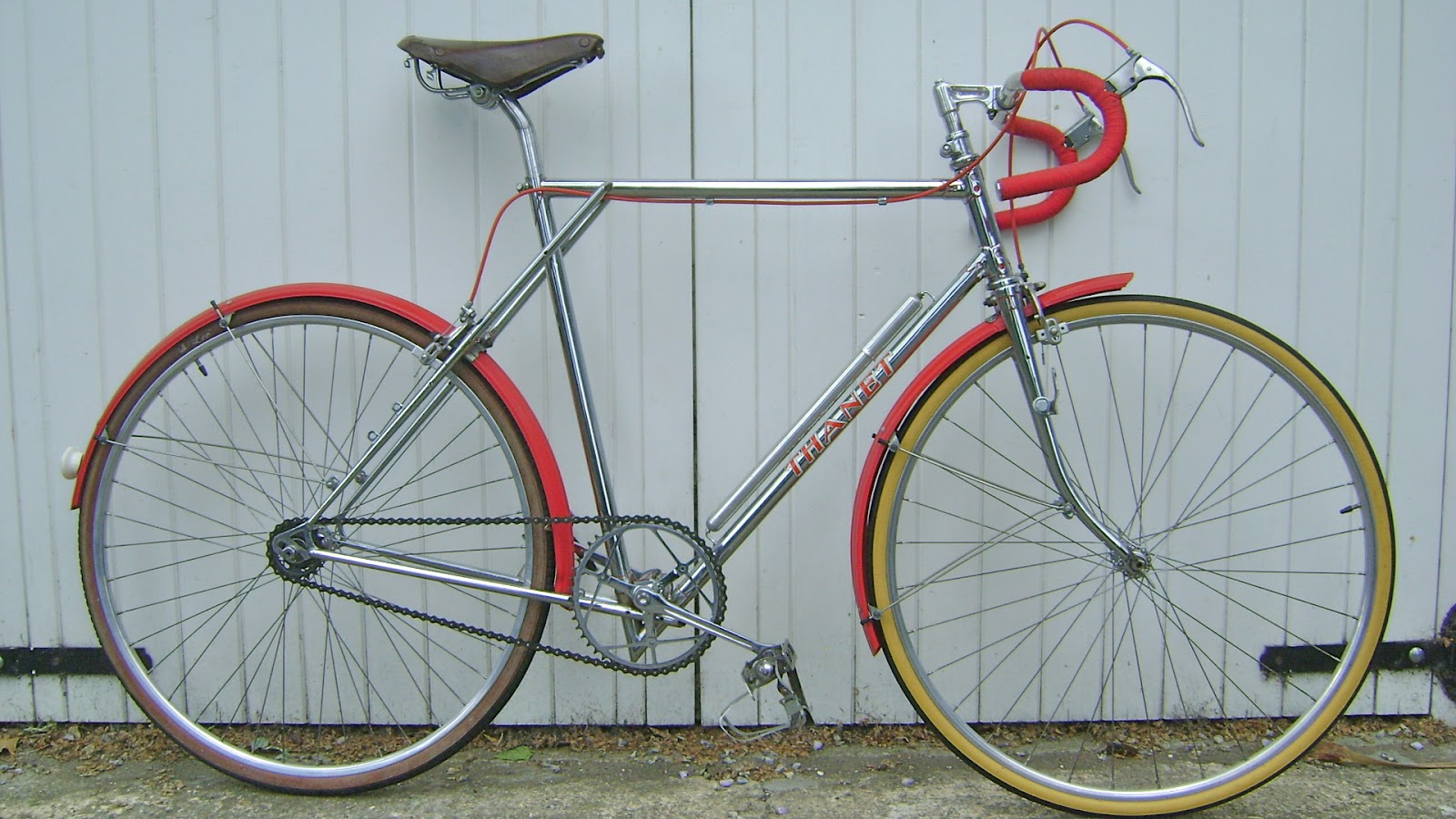
The 1950 Thanet Silverlight, as I purchased it in 2011 with a single-speed, fixed wheel

The journey is unexceptional by cycling enthusiast standards. At least it would be if it weren’t for the fact that I am 60 years old on April 1st, and the bicycle upon which I’m undertaking the journey is about 18 months older, having first been sold on 22nd October 1950 to someone by the name of ‘Miriam’ residing in Liverpool.

Both the bicycle and I are going back to the place of our birth. The Thanet Silverlight road bike was made at 50 Elmdale Road, Bedminster, Bristol. The address is now a private house and I doubt very much that the present residents know about its place in cycling history. I was born 5.8 miles away in Southmead Hospital, Bristol.

I thought that the first ride of my 60th year should be something a little different. Taking one of only a hundred or so Thanet Silverlight’s known to exist back to where it was created gives the journey a purpose of sorts. It’s a challenge I’m looking forward to with a mixture of excitement and trepidation. The word ‘Pyrenees’ looms large in my mind!